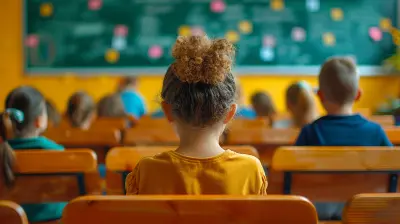
The Rise of AI in University Classrooms by 2027
5 May 2026
So, here we are. It's 2027, and if you walk into a university lecture hall, you might not see a professor at the front of the room. Instead, you'll see a hologram of a friendly, disembodied head named "Claude" or "GPT-7" droning on about the fall of the Roman Empire. And guess what? The students aren't taking notes. They're staring at their laptops, where an AI is already writing their essay on the fall of the Roman Empire. Is this progress? Or is it just a very expensive way to teach a robot to do your homework?
Let's be real: the rise of AI in university classrooms by 2027 isn't some sci-fi fantasy anymore. It's already happening, and it's happening faster than a freshman can binge-watch a semester's worth of lectures on 2x speed. I'm not here to scare you. I'm here to laugh at the absurdity of it all, and maybe, just maybe, help you figure out if you should be worried or just start practicing your "I was a human student in 2027" stories for your grandkids.

The Professor Is Now a Chatbot (Sort Of)
Remember that old professor who wore tweed jackets and smelled like old books and coffee? Yeah, he's probably still there, but now he's got an AI assistant that does 90% of his work. By 2027, many universities have fully embraced "AI Teaching Assistants." These aren't just glorified spell-checkers. They're full-on digital creatures that can answer student questions at 3 AM, grade multiple-choice tests in 0.2 seconds, and even generate personalized study plans based on your browsing history.But here's the kicker: these AI TAs don't get tired, don't complain about grading 200 papers, and definitely don't have to deal with that one student who asks, "Will this be on the test?" for the tenth time. They just keep smiling (if they have a face) and outputting information. It's efficient, sure. But it also means that the human connection-the awkward jokes, the off-topic rants, the professor accidentally calling you by the wrong name for a whole semester-is slowly fading away.
And let's be honest: who's going to miss the professor's off-topic rants? Probably no one. But what about the moments when a real human says something that changes your life? Can a chatbot do that? I'm not sure. But I am sure that by 2027, you'll have a better chance of getting a quick answer from an AI than from a human professor who's too busy applying for grants.

The Student Who Never Cracks a Book (But Still Gets an A)
Here's the part that makes traditionalists cry into their coffee. By 2027, the average university student has access to AI tools that can write a 10-page research paper in under five minutes. And I'm not talking about some clunky, copy-paste job. I'm talking about a paper that uses proper citations, has a coherent thesis, and even includes a subtle joke in the introduction to make it seem "human."Universities are now in a full-blown arms race. On one side, you have students using AI to do their work. On the other side, you have AI detectors that are supposed to catch them. But here's the dirty secret: the AI detectors are also trained by AI. So it's basically a battle of algorithms versus algorithms. The student's AI writes the paper, the professor's AI checks it, and somewhere in the middle, a human being (the professor) just shrugs and gives everyone a B-plus.
The result? A generation of students who are masters at prompt engineering but can't write a sentence without a digital crutch. It's like learning to drive by watching a self-driving car. You'll know the theory, but when the battery dies, you're stuck in the middle of the road. And by 2027, that's exactly where we are: stuck in the middle of a road paved with good intentions and zero critical thinking.

The Death of the Lecture (Long Live the Algorithm)
Let's talk about the lecture hall itself. You know, that big room with the uncomfortable chairs and the faint smell of desperation. By 2027, the traditional lecture is basically a museum piece. Universities have realized that if you're going to pay a professor to talk for an hour, you might as well just record it and let an AI summarize it for you.Instead, classes are now "asynchronous hybrid AI-enhanced modules." That means you log into a platform, watch a 10-minute video generated by an AI that adapts to your learning style, then answer a bunch of questions that are also generated by AI. If you get something wrong, the AI gives you a different explanation, in a different tone, maybe even in a different language. It's personalized, efficient, and utterly devoid of human warmth.
But here's the thing: the algorithm doesn't care if you're having a bad day. It doesn't care if you just broke up with your partner or if your cat died. It just wants you to master the material. And in a weird way, that's kind of refreshing. No judgment, no pity, just pure, cold, data-driven instruction. But it also means that the best part of college-the random conversations after class, the study groups that turn into parties, the professor who stays late to help you understand a concept-are becoming relics of the past.

Cheating Is Now an Art Form (And It's Legal)
If you think cheating in 2023 was bad, wait until you see 2027. By then, cheating has evolved from a shameful act into a legitimate academic strategy. I'm not saying it's right, but it's happening. Students are using AI to write entire dissertations. They're using voice-cloning software to fake oral presentations. They're even using deepfake technology to show up to class when they're actually at the beach.And the universities? They're not even mad. They're just confused. Some schools have started to embrace the chaos. They've created "AI-authorized" assignments where you're required to use AI to complete the work. The catch? You have to document every single prompt you used, and then the AI grades your AI's output. It's like a robot judge in a robot beauty pageant.
But here's the real punchline: the students who are cheating are often the ones who are most prepared for the real world. Think about it. In the job market, you're going to use AI tools to write emails, analyze data, and generate reports. So why not practice that in college? The problem is that it undermines the entire point of education, which is supposed to be about learning how to think, not just how to prompt. But hey, who needs critical thinking when you have a subscription to ChatGPT-8?
The University's New Business Model: Selling AI Subscriptions
Let's not pretend that universities are doing this out of the goodness of their hearts. By 2027, the business model of higher education has shifted dramatically. Tuition is still through the roof, but now you also have to pay for "AI access fees." That's right. You're paying the university for the privilege of using their AI tools, which are basically just reskinned versions of free software you could get online.It's like buying a bottled water at a concert. You could get it for free from the tap, but you're paying because you're trapped and thirsty. The universities have cornered the market on academic AI. They've partnered with tech companies to create "campus-specific" AIs that know your syllabus, your professor's grading quirks, and even the campus Wi-Fi password. It's convenient, but it's also a giant cash grab.
And the best part? If you don't pay for the premium AI tier, you get the "basic" version, which is slower, dumber, and occasionally throws ads for energy drinks at you. "Tired of studying? Try Monster!" said your academic AI. Welcome to the future, where even your education is monetized.
The Lonely Campus (But Highly Productive)
One of the most underrated effects of AI in universities by 2027 is the loneliness. Campuses are emptier than ever. Why go to a lecture when you can watch it from bed? Why join a club when an AI can simulate social interaction? Why talk to a human when you can get better advice from a chatbot?The result is a generation of highly productive, deeply isolated students. They're acing their classes, but they don't know how to make friends. They're getting degrees, but they're losing the ability to read social cues. It's like we've optimized the learning part of college but completely forgot the "life" part.
And the universities? They're not helping. They've replaced counseling centers with AI therapists that use cognitive behavioral therapy algorithms. They've replaced social events with "virtual meetups" where you talk to an avatar. It's efficient, but it's also a little bit sad. I mean, is this really what we wanted? To trade human connection for a 4.0 GPA?
The Great AI Backlash (Coming Soon to a Campus Near You)
But here's the twist. By late 2027, there's already a growing movement of students and professors who are pushing back. They're calling it "The Analog Renaissance." These are the people who refuse to use AI in their classes. They write by hand. They read physical books. They have actual conversations.It's a small movement, but it's loud. And it's gaining traction because people are starting to realize that AI is a tool, not a replacement. You wouldn't let a calculator teach you math, so why let an AI teach you history? The irony is that the people who are most vocal about rejecting AI are often the ones who understand it best. They're not Luddites. They're just tired of being optimized.
So, by the end of 2027, the university classroom is a battlefield. On one side, you have the AI evangelists who think every problem can be solved with a prompt. On the other side, you have the humanists who think that learning is about struggle, failure, and messy, beautiful imperfection. And in the middle, you have the rest of us, just trying to graduate without losing our minds.
What's Next? (Spoiler: More AI)
I wish I could tell you that the rise of AI in university classrooms by 2027 is a temporary phase. But it's not. It's the new normal. And the only thing you can do is adapt. Learn how to use AI without becoming dependent on it. Find the balance between efficiency and humanity. And for goodness' sake, don't let a robot write your love letters.Because at the end of the day, the best thing about education is that it's about people. And people are messy, unpredictable, and wonderful. AI can't replicate that no matter how many terabytes of data it's trained on. So, by 2027, when you're sitting in a classroom with a hologram professor and a chatbot TA, remember: you're still the one in control. Or at least, that's what the AI is telling me to say.
all images in this post were generated using AI tools
Category:
Higher LearningAuthor:

Eva Barker
Discussion
rate this article
2 comments
Rex Mathews
Sure, AI in classrooms sounds fancy, but are we trading real learning for tech shortcuts? By 2027, will students be creators or just passive consumers? If we let tech dictate education, we might just be programming the next generation of robots...
May 12, 2026 at 11:29 AM
Eva Barker
You raise a crucial point. It's about balance. AI can enhance learning, but the goal should always be to empower students as creators, not just consumers. Let's ensure tech serves education, not the other way around.
Ursula Peterson
This article highlights an exciting trend. AI's integration into classrooms could personalize learning and improve efficiency. However, we must consider potential downsides, like reliance on technology and the importance of maintaining human interaction in education. Balance is key.
May 5, 2026 at 10:24 AM
Eva Barker
Thanks for your insights! I agree that while AI can enhance learning, finding the right balance between tech and human interaction is essential.