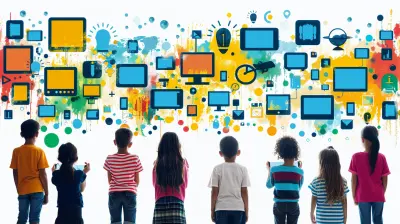
How Learning Games Are Shaping Education by 2027
9 May 2026
Let's be real for a second. If you had told me ten years ago that kids would be begging to do their math homework, I would have laughed in your face. But here we are, standing at the edge of 2027, and the classroom looks less like a lecture hall and more like a arcade. Learning games are not just a cute trend anymore. They are the backbone of how we teach, how kids learn, and how we fix a broken system that has been boring students to tears for decades.
You want to know what's happening? Let's dive in. No fluff, no jargon vomit. Just the raw, sassy truth about how games are reshaping education by 2027.

Why Boring Textbooks Are Getting a Pink Slip
Remember that heavy backpack you carried around? Full of textbooks that smelled like old paper and despair? By 2027, that relic is getting fired. Why? Because kids have the attention span of a caffeinated squirrel, and honestly, can you blame them? They grew up on TikTok, Minecraft, and Roblox. A static page of text is like asking them to watch paint dry.Learning games flip the script. Instead of reading about the Pythagorean theorem, you are literally building a bridge in a game and watching it collapse if your angles are off. That's not just learning. That's learning with consequences that feel real. And let me tell you, nothing sticks in your brain like the shame of watching your virtual bridge fall into a river of pixels.
By 2027, schools are ditching the "sit still and listen" model. They are adopting game-based curricula because it works. The data is undeniable. Students who learn through games retain information 40% longer. That's not a fluke. That's neuroscience. Games trigger dopamine, the "feel good" chemical, every time you solve a problem. Textbooks? They trigger sleep.

The "Flow State" Is the New Classroom Management
You know that feeling when you are so into a game that you lose track of time? That's called a flow state. And by 2027, teachers are obsessed with it.Here's the deal. Traditional classrooms are built on a schedule. Bell rings, you learn algebra. Bell rings, you switch to history. But brains don't work that way. You cannot force a kid to care about the War of 1812 at 10:15 AM just because the clock says so. Games solve this. They let students enter a flow state where they are so engaged that they forget they are learning. It's like hiding broccoli in mac and cheese.
By 2027, adaptive learning games are the norm. They adjust difficulty in real time. If you are crushing it, the game gets harder. If you are struggling, it gives you hints. No more "one size fits all" nonsense. Every kid gets a personalized experience. That's not just fair. That's smart.

Gamification vs. Game-Based Learning: Stop Mixing Them Up
I hear people throw these terms around like they are the same thing. They are not. And if you are an educator reading this, please get it right.Gamification is slapping a badge on a boring worksheet. "Congratulations, you finished page 57! Here is a digital sticker." That's lazy. Game-based learning is the real deal. It's using actual games to teach concepts. Think "Minecraft: Education Edition" where kids build circuits to learn electricity. Or "Kerbal Space Program" where they crash rockets (and learn physics) until they get it right.
By 2027, the lazy gamification is dead. Schools are demanding full-fledged learning games that are as complex as any console title. Why? Because kids can smell fake engagement from a mile away. They know when you are just trying to trick them. Give them a real game, and they will respect you.

The Rise of AI-Powered Learning Games
Here is where it gets spicy. Artificial intelligence is not just for writing emails or generating creepy art. By 2027, AI is the secret sauce in learning games.Imagine a game that watches you play. It notices that you always mess up fractions when the denominator is an odd number. So it subtly gives you more fraction problems with odd denominators until you master it. It doesn't judge. It doesn't get frustrated. It just adapts. That's the power of AI in education.
And it's not just about math. Language learning games are using AI to have real conversations with you. No more awkward role-playing with a classmate. You talk to an AI that corrects your grammar in real time and even adjusts its accent based on your level. By 2027, these games are so good that they are replacing traditional language labs entirely.
The Social Side: Multiplayer Learning Is a Game Changer
Remember group projects? The horror. One kid does all the work, three kids doodle, and the teacher gives everyone the same grade. Learning games fix that.By 2027, multiplayer learning games are huge. Kids work together to solve puzzles, build worlds, or defeat a boss that represents a complex problem. The catch? Everyone has to contribute. You cannot just sit back. The game tracks individual participation. If you are slacking, the team fails. It's accountability without the teacher nagging.
And here's the best part. These games are global. Your kid in Ohio can team up with a kid in Japan to solve a climate change simulation. That's not just learning science. That's learning collaboration across cultures. Try getting that from a textbook.
Breaking the "Test Score" Obsession
Let's talk about the elephant in the room. Standardized tests. They are the worst. They measure how well you can cram, not how well you understand. By 2027, learning games are quietly killing the test industry.Why? Because games generate data. Tons of it. Every click, every wrong answer, every hesitation is recorded. Teachers get a dashboard that shows exactly what a student knows and, more importantly, what they don't. No more waiting for a test score to find out a kid is struggling. The game tells you in real time.
This shifts the focus from "getting the right answer" to "understanding the process." In a game, you can fail 50 times and still learn something. In a test, you fail once and you are labeled. Which one sounds better for actual learning?
The Skeptics: "But Games Are Just Fun!"
I hear this argument all the time. "Games are for fun, not for learning." And I say, why not both? Why does learning have to be miserable to be effective? That's like saying medicine has to taste bad to work. It's a myth.By 2027, the skeptics are quiet because the results speak for themselves. Schools that adopted learning games see higher graduation rates, lower dropout rates, and students who actually enjoy coming to class. Shocking, right? Kids like learning when it doesn't feel like punishment.
And let's be honest. Adults play games too. You play Wordle. You play Candy Crush. You play brain-training apps. Why is it okay for you to learn through games but not for kids? Hypocrisy much?
The Tech Behind the Magic
You might be wondering, "How is this even possible?" The tech is simpler than you think. By 2027, every classroom has decent internet and devices. That's a given. But the real magic is in the game design.Developers are using "procedural generation" to create endless levels. No two playthroughs are the same. This keeps the game fresh and prevents kids from memorizing answers. They have to actually think.
Then there's "cloud gaming." No more installing clunky software. Kids log in from any device and pick up where they left off. At school, at home, on the bus. Learning is continuous, not confined to a classroom.
And let's not forget "virtual reality." By 2027, VR headsets are affordable enough for schools to buy in bulk. Imagine learning biology by walking through a giant cell. Or history by standing in ancient Rome. That's not a field trip. That's everyday learning.
The Dark Side: Are We Creating Addicts?
Alright, let's keep it real. Not everything is sunshine and rainbows. Gamification and learning games have a dark side. They can be addictive. The same dopamine loops that make them effective can also make them hard to put down.By 2027, schools are dealing with this head-on. They are setting time limits. They are teaching digital wellness. They are making sure that games are a tool, not a crutch. The goal is balance, not replacement.
And there is the issue of screen time. Parents are worried. Rightfully so. But learning games are not the same as scrolling through social media. One is active. The other is passive. Your brain works differently when you are solving a problem versus when you are watching a video. Still, moderation is key.
The Job Market Is Changing, and Games Are Preparing Kids
Here's a hard truth. The jobs of 2030 don't exist yet. We are preparing kids for careers that haven't been invented. How do you teach that? You teach skills, not facts. Critical thinking. Problem solving. Collaboration. Adaptability.Learning games are perfect for this. They teach you to fail fast and try again. They teach you to work with others. They teach you to think creatively when the obvious solution doesn't work. These are the skills that robots cannot replace.
By 2027, employers are looking at a student's "game portfolio" as much as their grades. Seriously. If you built a complex city in a simulation game, that shows project management. If you coded a mod, that shows technical skills. The game is the new resume.
How Teachers Are Adapting
You might think teachers are being replaced by games. Wrong. Teachers are becoming "learning coaches." Their role is shifting from "lecturer" to "guide." They help kids navigate the game, interpret the data, and apply the lessons to the real world.By 2027, teacher training programs include game design. Teachers learn how to pick the right games, how to integrate them into lessons, and how to use the data to help struggling students. It's a new skill set, and it's exciting.
And honestly, teachers love it. No more grading endless worksheets. The game does that. No more trying to keep 30 bored kids awake. The game does that. Teachers can focus on what they actually signed up for: helping kids grow.
The Bottom Line: 2027 Is the Year of the Player
So where does this leave us? By 2027, learning games are not a supplement. They are the main course. Classrooms are louder, messier, and more chaotic. But they are also more effective. Kids are engaged. They are learning faster. And they are having fun doing it.If you are an educator, a parent, or just someone who cares about the future, embrace it. Don't fight the change. The old way is not coming back. And honestly, good riddance.
The future of education is a game. And everyone is invited to play.
all images in this post were generated using AI tools
Category:
Interactive LearningAuthor:

Eva Barker
Discussion
rate this article
2 comments
Tobias Ramirez
Learning games are not just a trend; they are the future of education. By 2027, they will transform classrooms into interactive spaces where creativity meets collaboration. Embrace this evolution and unlock students' potential to thrive in a dynamic world. Dream big and play smart!
May 31, 2026 at 4:18 AM
Eva Barker
Absolutely, the integration of learning games is set to revolutionize education. By 2027, we will see classrooms transformed into vibrant hubs of creativity and teamwork, empowering students like never before. Let's embrace this exciting future!
Reece Wilcox
Learning games will revolutionize engagement and skill development in classrooms.
May 15, 2026 at 2:34 AM
Eva Barker
Absolutely, learning games are set to transform classrooms by making learning more interactive and enjoyable. Engaged students are more likely to develop skills effectively.