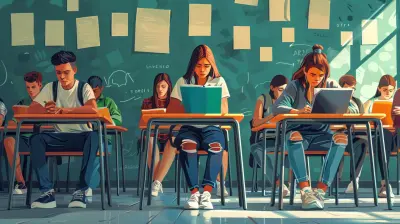
Curriculum Overhaul: What Subjects Are Disappearing by 2026
20 May 2026
You remember that one class in high school where you spent a whole semester learning how to balance a checkbook, only to never touch a checkbook again? Or maybe you sat through a year of typing on a manual typewriter, thinking, "When will I ever use this?" Well, buckle up, because the education world is shaking things up again. By 2026, a lot of the subjects you and I grew up with are getting the boot. And I'm not talking about small tweaks. I'm talking about a full-blown curriculum overhaul that's going to make some old favorites vanish from the classroom.
Let's be real: the world has changed faster than a teenager's TikTok feed. Schools are finally catching up. They're ditching dusty, outdated classes to make room for skills that actually matter in 2026 and beyond. But here's the kicker: not everyone is happy about it. Some folks are clutching their pearl necklaces, crying, "But what about cursive? What about ancient history?" And I get it. Change is scary. But let's walk through this together, like two friends comparing notes at a coffee shop, and figure out what's really disappearing and why.
The Great Subject Purge: Why Now?
Think of the school curriculum like an old closet. You've got clothes from 1995 that don't fit, are out of style, and smell a bit musty. But you keep them because, well, you might wear them again someday. Spoiler alert: you won't. That's exactly what's happening with subjects in schools. The curriculum has been stuffed with courses that served a purpose decades ago but are now collecting dust in the educational attic.Why 2026? Because that's when a massive wave of state and national education standards are set to roll out. Countries like the UK, Australia, and parts of the US are pushing for a "future-ready" curriculum. The driving force? Technology, the job market, and a big, fat wake-up call from the pandemic. We realized that kids don't need to memorize the capital of every country when they can Google it in two seconds. They need to know how to think, adapt, and solve problems that don't even exist yet.
So, what's on the chopping block? Let's dive into the subjects that are waving goodbye by 2026.
1. Cursive Handwriting: The Art of the Past
Remember the hours you spent perfecting those loops and swirls? The teacher would say, "You'll need this for college applications!" Well, spoiler: most of us typed our applications. Cursive is one of the first subjects to get the axe. By 2026, many schools will no longer teach it as a standalone skill. Some states in the US have already dropped it from required standards.Why? Because it's inefficient. Kids type faster than they write, and most adults only use cursive to sign a credit card slip (if that). Plus, with digital devices everywhere, who's passing handwritten notes anymore? It's a romantic skill, sure, like knowing how to churn butter. But in a world of keyboards and voice-to-text, cursive is becoming a relic.
But here's the counterargument: some studies say cursive boosts brain development and fine motor skills. I'm not denying that. But schools are asking, "Is the time spent on cursive worth more than, say, coding or financial literacy?" The answer is leaning toward a hard no. So, if your kid is still struggling with cursive, don't sweat it. They'll be fine typing their essays.
2. Home Economics: From Sewing to Survival Skills
Home economics used to be the class where you learned to sew a button, bake a cake, and maybe balance a budget. But by 2026, it's essentially disappearing in its traditional form. Why? Because the world of "home" has changed. Who sews their own clothes anymore? We buy fast fashion. Who bakes from scratch regularly? We order takeout. The old Home Ec is being replaced by "Life Skills" or "Modern Living" classes that focus on things like meal planning on a budget, digital organization, and even mental health management.But here's where it gets interesting: some schools are keeping the cooking part but ditching the sewing. They're teaching kids how to prepare healthy, affordable meals in under 30 minutes. That's practical. But the old "Home Ec" label? It's gone. It's being rebranded into something more relevant. So, if you loved that class, mourn it for a second. Then realize that your kids are learning how to use a slow cooker instead of a sewing machine.

3. Typing Class: The Rise of the Keyboard
Wait, typing class is disappearing? Didn't we just establish that kids need to type? Yes, but here's the twist: typing class as a separate subject is vanishing because it's already integrated into everything else. Remember when you had to sit in a lab with giant monitors and practice "asdf jkl;" for an hour? That's over. Kids today learn to type by, well, typing. They're on devices from age two. By the time they hit middle school, most can type faster than you can dictate.By 2026, dedicated typing classes will be rare. Instead, schools are folding keyboarding skills into computer literacy or even English class. It's like teaching someone how to breathe. It's so fundamental that it doesn't need its own room. So, if you were hoping your kid would learn proper finger placement, don't worry. They'll pick it up naturally. And if they don't? Voice typing is getting pretty good.
4. Long Division and Memorizing Math Facts
Okay, math lovers, brace yourselves. Long division is on the outs. I'm not saying math is disappearing. Far from it. But the way we teach math is changing radically. By 2026, many schools are ditching the drill-and-kill approach: the endless worksheets of long division, memorizing multiplication tables, and reciting formulas. Why? Because calculators and apps do that instantly.Instead, math classes are focusing on conceptual understanding, data analysis, and real-world problem solving. Think of it this way: do you need to know how to calculate the square root of 144 by hand? Or do you need to understand what a square root means and when to use it? Schools are betting on the latter. They're teaching kids to think like mathematicians, not to act like human calculators.
But here's the catch: some basic arithmetic is still essential. You can't rely on a calculator to tip at a restaurant. So, don't panic. They're not throwing out addition and subtraction. They're just saying goodbye to the tedious, time-consuming methods that made you cry in 4th grade.
5. Traditional History Timelines: Goodbye, Date Memorization
Raise your hand if you had to memorize the year the Magna Carta was signed. (1215, by the way. See? I remember it, but I've never used it.) History classes are getting a major facelift by 2026. The old approach of memorizing dates, names, and events is fading fast. Why? Because that information is literally in your pocket. Ask Siri.Instead, history is becoming more thematic and skills-based. Schools are focusing on critical thinking, source analysis, and understanding historical patterns. For example, instead of memorizing the battles of World War II, students might analyze propaganda posters or debate the ethical implications of war. It's about teaching kids how to interpret the past, not just recite it.
The traditional "survey course" that covers everything from the Stone Age to the Cold War? It's being replaced by deeper dives into specific topics: colonialism, migration, technology, and social justice. By 2026, you might not find a class called "World History" on the schedule. You'll find "Global Perspectives" or "Historical Inquiry." It's less about what happened and more about why it matters.
6. Art and Music as Separate Subjects
This one hurts. Art and music are being cut in many schools, but not in the way you think. By 2026, they're not disappearing entirely. They're being integrated into other subjects or turned into elective "specials." The standalone "Art 101" or "Choir" class is becoming a luxury in some districts. Why? Budgets. And a push for STEM (Science, Technology, Engineering, Math) to become STEAM (add Art). But the "A" in STEAM is often treated like an afterthought.Here's the reality: schools are prioritizing "hard skills" that lead to jobs. Art and music are seen as soft skills. But that's a mistake. Creativity is crucial for innovation. Still, many districts are cutting these classes to make room for coding, robotics, and digital media. So, the old watercolor painting class? It might be replaced by a graphic design course. The band practice? It might become a music production class using digital software. The essence remains, but the medium changes.
7. Foreign Languages: The Rise of Mandarin and the Fall of French
Remember when taking French or Spanish was a given? By 2026, the language menu is shrinking. Many schools are dropping less commonly taught languages like Latin, German, or even French in favor of Mandarin Chinese, Arabic, and coding languages like Python. Wait, coding as a language? Yes. Some educators argue that "computer languages" are more useful for the future job market than conversational French.Let's be honest: how many of us actually use the Spanish we learned in high school? A few, sure. But most of us can't hold a conversation. Schools are realizing that language learning is hard and often ineffective in a classroom setting. So they're focusing on languages with high economic value. Mandarin is a big one. And coding? It's becoming a "second language" requirement in some forward-thinking districts.
But this shift is controversial. Critics say it's culturally narrow. They argue that learning a language opens doors to understanding other cultures. And they're not wrong. But the trend is clear: by 2026, your kid might have to choose between learning Python or Mandarin instead of Spanish or French.
8. Physical Education (PE) as We Know It
PE is not disappearing, but it's transforming. The old model of running laps, playing dodgeball, and doing sit-ups is on its way out. By 2026, many schools are replacing traditional PE with "wellness" or "fitness for life" classes. Why? Because dodgeball teaches aggression, not teamwork. And running laps doesn't teach kids how to stay active as adults.The new PE focuses on lifelong fitness: yoga, hiking, dance, weight training, and even mindfulness. It's less about competition and more about health habits. So, the class where you dreaded the mile run? It's being replaced by a class where you learn how to manage stress and eat well. That's a good thing, right? But for those who loved the competitive spirit, it's a loss.
9. Library Science: From Dewey Decimals to Digital Literacy
Remember going to the library and learning how to use the Dewey Decimal System? By 2026, that's gone. School libraries are becoming "media centers" or "innovation labs." The old librarian role is shifting to a "digital learning specialist." Instead of teaching kids how to find a book on a shelf, they're teaching them how to evaluate sources online, avoid misinformation, and use databases.The card catalog? A museum piece. The physical book? Still there, but taking a backseat. By 2026, the library as a quiet place to read is being replaced by a noisy hub for collaboration, coding, and podcasting. It's a radical shift, but one that reflects how we access information today.
What's Replacing These Subjects? The Future Curriculum
So, if all these subjects are disappearing, what's taking their place? Here's a sneak peek at the new classes popping up by 2026:- Digital Literacy and Cybersecurity: Kids learning how to spot phishing emails and protect their privacy.
- Financial Literacy: Not just balancing a checkbook, but understanding taxes, investing, and credit scores.
- Entrepreneurship and Innovation: How to start a business, pitch ideas, and fail gracefully.
- Climate and Sustainability: Understanding climate change and how to live sustainably.
- Mental Health and Emotional Intelligence: Managing stress, building relationships, and practicing self-care.
- Coding and AI Fundamentals: Not just using technology, but understanding how it works and how to create it.
These aren't just buzzwords. Schools are actually building curricula around them. For example, in Finland, they've already ditched traditional subjects for "phenomenon-based learning," where students study real-world topics like climate change or the European Union. By 2026, expect more of this globally.
The Human Cost of the Overhaul
Let's not sugarcoat it: this overhaul hurts some people. Teachers who have spent decades teaching cursive or home economics are being forced to retrain or lose their jobs. Students who thrived in traditional history or art classes might feel left behind. And parents? They're worried their kids are missing out on a "well-rounded" education.But here's the thing: education has always evolved. In the 1800s, we taught Latin and Greek because scholars needed them. In the 1900s, we added shop class and typing because factories and offices needed them. Now, in the 2020s, we're adapting to a digital, global, and unpredictable world. It's not about ditching the past. It's about building a future.
What You Can Do as a Parent or Student
If you're feeling anxious about these changes, you're not alone. Here's my advice: don't fight the tide. Instead, lean into it. Ask your school what new subjects are being introduced. Advocate for a balance between old skills (like critical thinking) and new ones (like coding). And remember: no single curriculum can prepare a kid for everything. The best skill you can teach is adaptability.By 2026, your child might not know how to write in cursive, but they'll know how to code a website. They might not know the date of the Battle of Hastings, but they'll know how to fact-check a news article. Is that a fair trade? Only time will tell. But one thing's for sure: the classroom of 2026 will look nothing like the one you sat in. And honestly? That's probably a good thing.
So, let's raise a glass (or a laptop) to the subjects that are disappearing. They served us well. But the future is calling, and it's time to answer.
all images in this post were generated using AI tools
Category:
Education BlogsAuthor:
Eva Barker
Discussion
rate this article
1 comments
Jennifer McGrady
Essential subjects lost; future learning at risk.
May 23, 2026 at 3:25 AM
Eva Barker
I understand your concern. Balancing essential subjects with evolving needs is challenging, but we aim to prepare students for the future. Your feedback is valuable.